Sunday, October 27, 2013

SSTEIN Research Proj- Raphael’s Cartoons for the Sistine Chapel #2

V & A (n.d) The Raphael Cartoons: What is a Cartoon? Retrieved from
            http://www.vam.ac.uk/content/articles/t/raphael-cartoons-what-is-a-cartoon/
   
            I want to step back in my research and just go over a little bit about what the cartoons were and how Raphael created them. In Renaissance art, a cartoon is basically a mock up or pre-design for a concept for a finished piece of artwork. Examples include the drawing of Leonardo’s Burlington cartoon that we learned about in the first quarter of our studies on Renaissance art. In Leonardo’s case the Burlington cartoon would have been used as a preliminary design for a painting. In Raphael’s case, he used these cartoons to create tapestries. The word cartoon is from the Latin word cartone. A cartone in Latin is a large piece of paper. If we step back a little farther in the process Raphael and his assistants would create small sketches called modelli, which were the basis of what was to later be drawn to create the cartoon. Each of the cartoon was pieced together with small pieces of paper. These small sheets were stuck together with a mixture of water and flower to act as an adhesive to hold them in place. The designs were painted with mixtures of animal glue, water, and different pigments. This mixture is laid on and worked to Raphael’s satisfaction. Once dried they were sent to be made into tapestries by weavers. The weavers would cut the material and begin weaving and sewing them together.
The cartoons were reconstructed during the 1690s. They were glued to canvas to strengthen them because with age they were becoming very fragile. The overlaps and connections within the tapestries were not put together evenly at times, this is shown in the picture below in an x-ray of Raphael’s tapestry, The Healing of the Lame Man.
Raphael’s cartoon tapestries were so beautiful with eh amount of detail and with his subtle use of colour pallet. For this reason it is thought that Raphael wasn’t creating these cartoons as a pre-design or concept for a final piece. Raphael may have intended the tapestries to be a finished work of art and not just a cartoon or preparatory design.

Saturday, October 12, 2013

SSTEIN Research Proj- Raphael’s Cartoons for the Sistine Chapel


SSTEIN Research Proj- Raphael’s Cartoons for the Sistine Chapel Tapestries

Freedberg, Painting of the High Renaissance, Oberhuber, Hall. 269-280

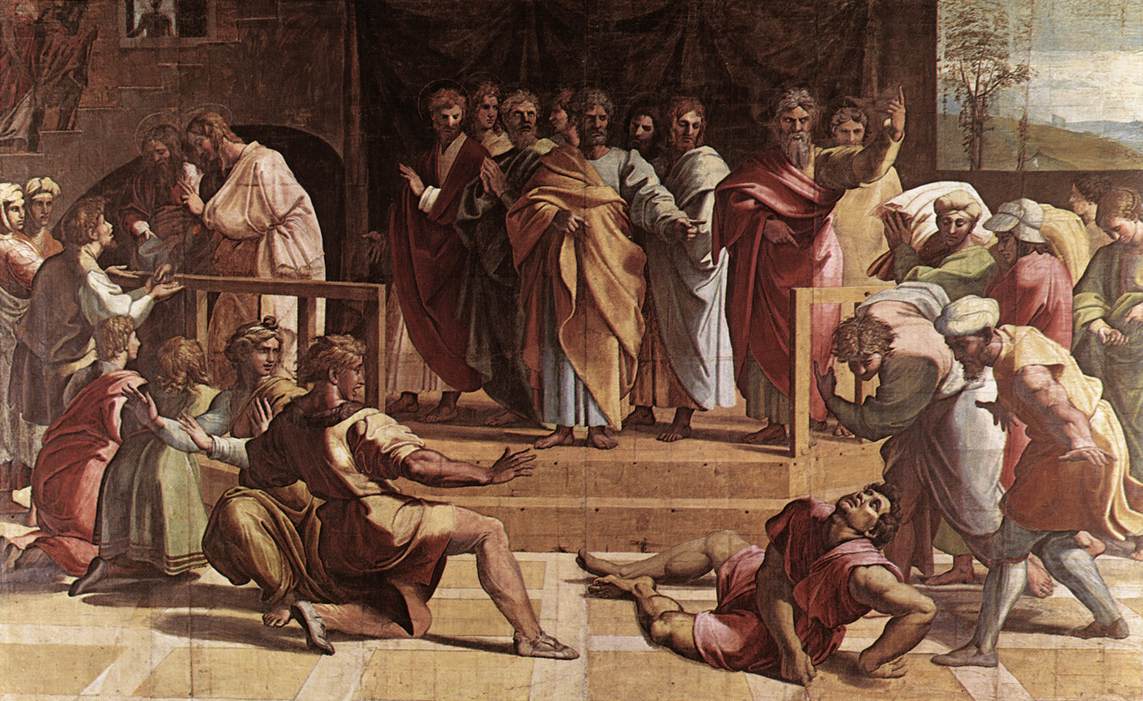
Raphael was the creator of 7 beautiful cartoons. They were created around the time of 1515 for the Sistine Chapel and now reside in the Vatican Museum in Rome. Only five of these beautiful cartoons exist today in the Victoria and Albert Museum in London.

There seems to be little on the preparations and sketches that Raphael prepared for the paintings of the tapestries. Only two drawing have been found of his studies that we know were created by him, other may have been from his assistants. Today not a single piece exists that shows the reflections of Raphael’s inventions in creating an entire tapestry. It is said that it could be possible that Raphael's partial studies for the tapestries was done by assistance under his supervision. These copies that have been found, may have been created by assistants to keep Leonardo’s works form being defaced. Penni was one assistant who helped create these studied with pen and ink also to simplify Leonardo’s work for ease of transfer. Raphael assistant Penni played a major role in helping paint and create the tapestries whereas other assistance helped with creating the designs for the borders.

The tapestries can be viewed from both the front and reverse because of the nature of the medium. They seem to be more of an invention rather than an aesthetic attribute. The reversal of the tapestries has an effect with the designs that are directional. There is a better fluidity to the pieces when flipped. Raphael worked in a counter gestalt when creating the tapestries. Which is basically in a reverse of the original idea. When the tapestries is reversed from its original gestalt it is only so little weakened.

The Paul and the Peter tapestries were originally placed in an architectural setting that would show the reticence aesthetic and practical use in lighting. Each tapestry would receive the proper angle and amount of light. Each tapestry has a unique design, yet each one relates to the next in a sequence. The landscape appears to be have a continuance in both.

On the long walls there is three scenes. The scenes seem to have no correspondence within each other, but each of them is concordant in indication of direction. The Pasce Oves shows movement and narration to the right. The figures in the scene are arranged against the landscape giving a monumental and architectural effect. In the Healing of the Lame, the tapestry has a dense populace of figures creating a strong architectural effect. The design is more central, but a direction to the right is slightly implied. It relaxes the viewer to the right. The last tapestry is the Death of the Ananias is the lost stable in it structure. It emphasizes the direction like the others, but also counteracts direction. It is directed in reverse the other to the left. This creates a beautifully constructed balance of the three tapestries.
File:V&A - Raphael, The Healing of the Lame Man (1515).jpg
File:V&A - Raphael, The Death of Ananias (1515).jpg

SSTEIN--- Sir Anthony Blunt. Artistic Theory in Italy 1450-1600

SSTEIN--- Sir Anthony Blunt. Artistic Theory in Italy 1450-1600
                                Leonardo, 23-38 and Michelangelo, 58-81

 MICHELANGELO


Michelangelo’s artistic theories can be broken into three different periods in the first period; Michelangelo follows a view on arts that is influenced greatly by high renaissance humanism. Like Leonardo he was influenced by the scientific tradition of scientific tradition of Florentine art. However, Michelangelo was focused more on beauty than science and truth. Michelangelo's work shows heroic quality and emphasizes beauty of the human body. He did not believe in exact imitation of nature. He beloved in the beauty of nature and he put emphasis on it in his works. Michelangelo would paint his Venus by using a mixture of beautiful features on women to create the perfect woman. He wanted to capture the male gaze. 
 
                With the split of the church and weakening of the pope, a change in outlook affected Michelangelo's works. In his painting, the last judgment he didn’t make the nude beautiful like he once had. Instead the bodies were lumpy, heavy, and ungraceful. He wasn’t looking for beauty, more of a spiritual meaning. He is conveying that physical beauty will pass. Love is spiritual. But love is triggered most easily through beauty and what we see.  He was becoming spiritually minded in has age and beauty was becoming less of the physical world and more of the spiritual world. His work was more toward the inward mental image and still less of the naturally world. 
 
                Michelangelo created many sculptures. He said that he created these sculptures not only with his ideas but the as a subtractive process the form was already within the stone he was carving. As he carved at the stone his ideas would be revealed and uncovered trough his skills. In his statues he relied on his own imagination and inspiration rather than following standards of beauty laid forth by past artists. 
                In the last stages of his life, Michelangelo was extremely representative. He began to give up classical subjects and religious subjects. Instead he showed tragedy with nothing supernatural. He was working more towards spirituality and Christianity. 

 LEONARDO
                 Leonardo dominated the philosophical field of art. He was all about studding science and natural phenomenons of the world. He also studied mathematics to improve observation and experimentation. This is a bit different than that of Michelangelo because Leonardo loved nature and wanted to decipher everything that he could about it. He recorded what he actually saw in the anatomy of life form Plants animals and Humans. His strengths lie in the observation of natural phenomenon. His painting was a scientific study of perspective and nature. They are based on true principles of live from his own observations. He follows three facts when he paints: the eye is the sense that can least easily be derived, the painter does not rely on just his eye but measurements, and painting is based on the study of geometry. He describes that way he works as defining the world in the most perfect way he can. He says that people who ignore science will not be able to produce a good work of art.
                Leonardo uses light has one of his strongest ways to represent the real world. Without the study of light and shadow a painting will not appear believable or real. It needs to have relief to create dimension. He studied the colors they were made when a shadow was cast upon a certain object. He studied something much further that perspective, he studied atmospheric perspective, or how object become less focused from a distance. His paintings were mainly focused on this exact imitation of nature unlike Michelangelo. He stays away from improving the nature because it will only lead to the depiction of an unnatural world. As for anatomy he observes that all men can be well proportioned. The proportions are usually fixed to an ideal mans height. But he still urges people to realize that the men will vary in looks as most all people do. 
 
               As an inventor he encouraged new ideas, but did not believe in the creation of something that excels nature. All inventions must be plausible and real in nature itself. Leonardo is the perfect mix of scientific observer and imaginative creator to the point where his ideas are plausible and not too farfetched to be made realistic.

Thursday, October 3, 2013

SSTEIN -----Adam Gopnik RENAICANCE MAN The New Yorker


Leonardo was an intelligent weird individual. He spent his life making things that were unheard of but still seemed to function in this world.  Kemp writes about how Leonardo was constantly searching for a system of proportions.  This system of proportions would explain how gravity and forces work. Nicholl's book on Leonardo looks at his commissions in Florence and Milan. Leonardo’s life was strongly researched and observed because of his importance and intelligence. Nicholl describes Leonardo as a an appealing well rounded person with a strong sense of humor and very affectionate.                
                In Nicholl's and Kemp's books both show how Leonardo loved to paint, but hated being thought of as a painter.  Leonardo belittled other painters in his writings. He referred to Michelangelo’s figures as sacks of nuts. He talks about how Botticelli’s Annunciations depicts the angel trying to rape the virgin.
                The reading talks about whether or not Leonardo is a scientist or not. He isn’t, he is simply looking for vital form and analogy. He did experiment but not much. He was more interested in making horizontal connections in life. some of these include the relation of blood flow and rivers, and how the uterus is like the cosmos.
                Leonardo’s work was unusual and unlike any other before. His work had no real precedents, his work was all his own visions and autonomous standards. All people could do during the time of Leonardo was admire his unusual talents. He wanted to take his contemporaries ideas of an artist and transform it from a craftsmanship to genius.

SSTEIN--- Sir Anthony Blunt. Artistic Theory in Italy


SSTEIN--- Sir Anthony Blunt. Artistic Theory in Italy 1450-1600
                                Leonardo, 23-38 and Michelangelo, 58-81

 MICHELANGELO

Michelangelo’s artistic theories can be broken into three different periods in the first period; Michelangelo follows a view on arts that is influenced greatly by high renaissance humanism. Like Leonardo he was influenced by the scientific tradition of scientific tradition of Florentine art. However, Michelangelo was focused more on beauty than science and truth. Michelangelo's work shows heroic quality and emphasizes beauty of the human body. He did not believe in exact imitation of nature. He beloved in the beauty of nature and he put emphasis on it in his works. Michelangelo would paint his Venus by using a mixture of beautiful features on women to create the perfect woman. He wanted to capture the male gaze. 

                With the split of the church and weakening of the pope, a change in outlook affected Michelangelo's works. In his painting, the last judgment he didn’t make the nude beautiful like he once had. Instead the bodies were lumpy, heavy, and ungraceful. He wasn’t looking for beauty, more of a spiritual meaning. He is conveying that physical beauty will pass. Love is spiritual. But love is triggered most easily through beauty and what we see.  He was becoming spiritually minded in has age and beauty was becoming less of the physical world and more of the spiritual world. His work was more toward the inward mental image and still less of the naturally world. 

                Michelangelo created many sculptures. He said that he created these sculptures not only with his ideas but the as a subtractive process the form was already within the stone he was carving. As he carved at the stone his ideas would be revealed and uncovered trough his skills. In his statues he relied on his own imagination and inspiration rather than following standards of beauty laid forth by past artists. 

                In the last stages of his life, Michelangelo was extremely representative. He began to give up classical subjects and religious subjects. Instead he showed tragedy with nothing supernatural. He was working more towards spirituality and Christianity. 


 LEONARDO
                 Leonardo dominated the philosophical field of art. He was all about studding science and natural phenomenons of the world. He also studied mathematics to improve observation and experimentation. This is a bit different than that of Michelangelo because Leonardo loved nature and wanted to decipher everything that he could about it. He recorded what he actually saw in the anatomy of life form Plants animals and Humans. His strengths lie in the observation of natural phenomenon. His painting was a scientific study of perspective and nature. They are based on true principles of live from his own observations. He follows three facts when he paints: the eye is the sense that can least easily be derived, the painter does not rely on just his eye but measurements, and painting is based on the study of geometry. He describes that way he works as defining the world in the most perfect way he can. He says that people who ignore science will not be able to produce a good work of art.

                Leonardo uses light has one of his strongest ways to represent the real world. Without the study of light and shadow a painting will not appear believable or real. It needs to have relief to create dimension. He studied the colors they were made when a shadow was cast upon a certain object. He studied something much further that perspective, he studied atmospheric perspective, or how object become less focused from a distance. His paintings were mainly focused on this exact imitation of nature unlike Michelangelo. He stays away from improving the nature because it will only lead to the depiction of an unnatural world. As for anatomy he observes that all men can be well proportioned. The proportions are usually fixed to an ideal mans height. But he still urges people to realize that the men will vary in looks as most all people do. 

               As an inventor he encouraged new ideas, but did not believe in the creation of something that excels nature. All inventions must be plausible and real in nature itself. Leonardo is the perfect mix of scientific observer and imaginative creator to the point where his ideas are plausible and not too farfetched to be made realistic.